

Andy Burnham is an Everton supporter. Yet within 24 hours of Manchester City being found guilty of more than 100 financial-rule breaches, the British prime minister found himself explaining why he did not want the club’s Abu Dhabi owners to leave.
“I would be really concerned to lose them,” Burnham told the BBC on 30 September. He was not defending the accounting arrangements that an independent commission had just found concealed hundreds of millions of pounds of owner funding. He was talking about something much larger than the football club: the physical transformation of Manchester.
Burnham had spent nine years as mayor of Greater Manchester before becoming prime minister in 2026. During that period, investment connected to Manchester City’s Abu Dhabi ownership became increasingly woven into housing, regeneration, infrastructure and civic projects across the city-region.
Burnham described City’s owners as a major partner in building modern Manchester while also saying he would not interfere with the Premier League’s disciplinary process. Within a day, Downing Street was clarifying that the process remained independent and that established wrongdoing should bring consequences.
Manchester City therefore looks like an unusual subject for a prime minister only if it is treated solely as a football club.
Follow the ownership out of the Etihad Stadium and it leads into apartment blocks, development companies, public land, mayoral projects and ultimately Britain’s economic relationship with the United Arab Emirates.
Burnham is not accused of participating in Manchester City’s financial offences. The Premier League case is against the club. His connection is political and economic: he governed a region in which City’s owners became major investors, and he now leads the national government responsible for Britain’s relationship with the UAE.
That is how Manchester City followed Andy Burnham into Downing Street.
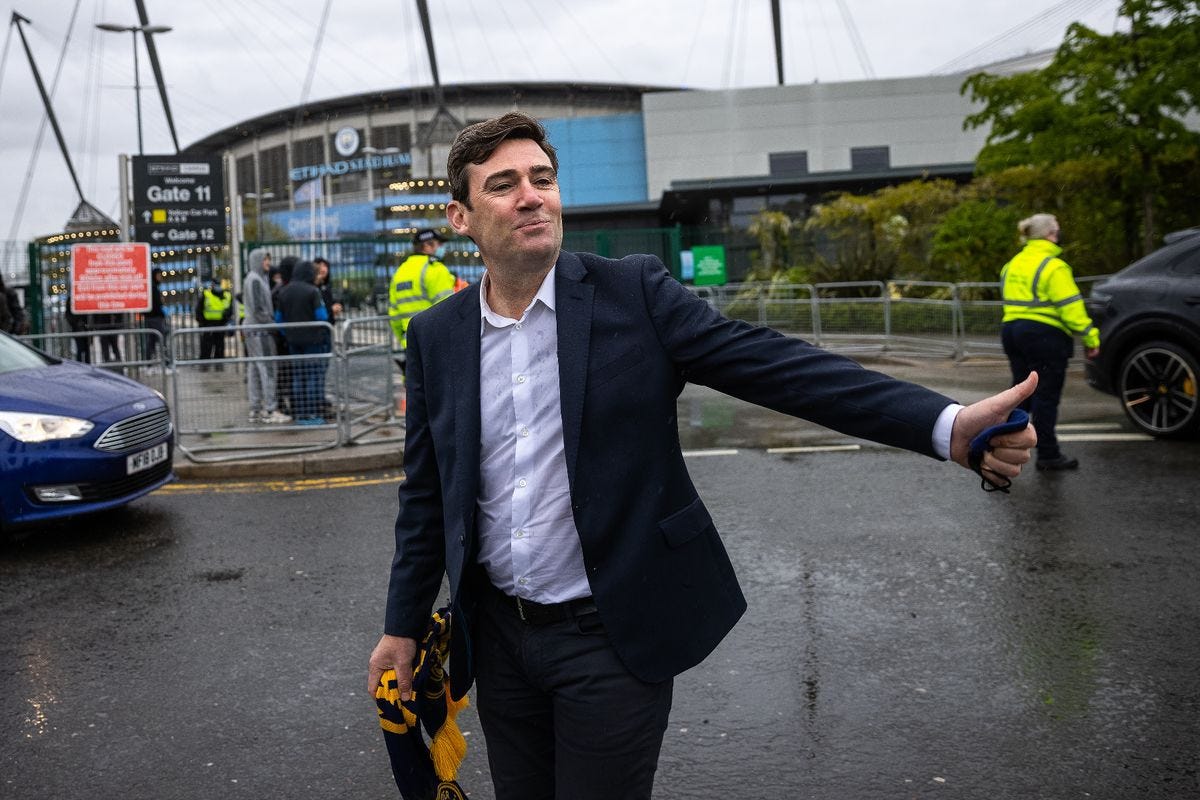
Manchester City’s ownership became part of Manchester’s regeneration story
Sheikh Mansour bin Zayed Al Nahyan bought Manchester City in 2008 through Abu Dhabi United Group, or ADUG.
The first transformation was obvious. Money flowed into the football club, then into the training ground and Etihad Campus around it. By 2014, however, the relationship had moved well beyond football.
That June, Manchester City Council and ADUG launched Manchester Life, a housing partnership focused initially on Ancoats and New Islington. The government described plans for up to £1 billion of investment over ten years, beginning with more than 830 homes and ambitions for thousands more.
Burnham was not yet mayor. The original deal was struck three years before he took office, and the public partner was Manchester City Council, not the Greater Manchester mayoralty.
What he inherited in 2017 was a city in which Manchester City’s ownership had already become part of the regeneration machinery.
The link was not accidental. ADUG director Marty Edelman said at the launch that the relationship built through Manchester City had helped bring Abu Dhabi investors into Manchester’s wider development plans. A football takeover had opened the door to a property partnership.
Manchester Life was also a business, not a charitable gift. New homes, construction and redevelopment could bring clear benefits to neighbourhoods that had endured years of decline, while the projects also created valuable property assets and rental income for the investors behind them.
By the time Burnham became mayor, he was therefore dealing with City’s owners in two different worlds at once: as custodians of the region’s most successful football club, and as investors with a growing physical stake in Manchester itself.
Public money also helped the Manchester Life projects grow
By the time Burnham became mayor in 2017, Manchester Life was already well established. Abu Dhabi money had helped push development eastwards from the city centre, but the projects did not rely on private capital alone.
Public institutions were involved too.
In October 2017, the Greater Manchester Combined Authority approved a £24.5 million loan for Manchester Life’s 213-home Lampwick development in New Islington. Other Manchester Life projects also received support from Greater Manchester’s housing investment fund.
That does not mean Burnham personally handed City’s owners public money. The loans were institutional decisions, made through established public financing structures, and should be treated as such.
But they complicate the cleaner version of the story in which Abu Dhabi simply arrived, spent heavily and rebuilt Manchester.
Later University of Sheffield research identified around £55 million in public loans across three Manchester Life developments and examined the use of public land through long leases. The researchers argued that these arrangements made it difficult to work out exactly how the benefits of regeneration were divided between the public sector and the private investors.
Their objection was not that nothing had been built. Manchester Life had clearly produced new housing and helped reshape parts of Ancoats and New Islington.
The question was what the public had put in, what the private partner had put in, and who ultimately captured the value created.
The researchers counted 1,468 homes across the developments they examined, most for private rent, and said no affordable housing had been delivered within those schemes. Manchester City Council defended the partnership and its wider regeneration effects. The report did not allege corruption.
For Burnham, the significance was practical. As mayor, he was not simply watching outside investors spend money in his region. He was governing a city-region whose public institutions were themselves helping finance parts of the same development model.
Abu Dhabi capital and Greater Manchester’s public resources had become intertwined in the redevelopment of the city.
City’s ownership also became part of Manchester’s civic life
The relationship did not stop with housing.
Manchester City says City Football Group and its partners have invested more than £700 million in east Manchester since 2008. The City Football Academy turned former industrial land beside the stadium into an 80-acre training complex. Later projects around the Etihad Campus added education, healthcare, entertainment and another major stadium redevelopment.
For a Greater Manchester mayor, City was becoming difficult to encounter only as a football club. The organisation sat inside the regeneration of a part of the city Burnham was responsible for, employed local people and increasingly appeared alongside public institutions on projects well beyond the pitch.
One of Burnham’s most visible connections came through Vincent Kompany.
When City’s former captain organised his testimonial in 2019, he turned it into a fundraising campaign for homelessness in Greater Manchester. His Tackle4MCR project supported Burnham’s A Bed Every Night programme, which provided emergency accommodation for people sleeping rough.
Ahead of the match, the Greater Manchester Combined Authority said the campaign had already raised more than £300,000, with further proceeds from the testimonial going to the same cause.
Burnham appeared alongside Kompany and was photographed at the event with Manchester City chairman Khaldoon Al Mubarak.
There was nothing covert about the relationship. This was a public football event raising money for one of the mayor’s flagship social programmes.
But Al Mubarak was never only a football chairman.
He chairs Manchester City and City Football Group, while also running Mubadala, one of Abu Dhabi’s principal sovereign investment companies. A conversation with him can therefore sit at the intersection of football, Manchester regeneration and much larger investment interests.
By the end of Burnham’s mayoralty, City’s Abu Dhabi ownership had become familiar not only through trophies and the Etihad Stadium, but through housing, development and civic projects that Burnham could point to when explaining why he regarded the relationship so positively.
Burnham had already explained why he defended City’s owners
Burnham’s position did not suddenly appear after the verdict. He had explained it three years earlier, while still mayor.
Asked in 2023 about Manchester City’s Abu Dhabi ownership on Pod Save the UK, Burnham did not begin with football. He began with east Manchester.
“Go to East Manchester now and look at photographs of it 30 years ago,” he said. A large share of the investment that had changed the area, he argued, had come from City’s owners. They were doing “more than building a football club”.
That answer fitted the world Burnham had spent years governing. He could point to new housing, the Etihad Campus and other investment around the club and argue that the ownership had left a visible mark on the city.
The harder question came when interviewer Coco Khan moved away from regeneration and raised the UAE’s human-rights record.
Burnham acknowledged the concern, but drew a boundary around his own role. “I’ve got to judge what I see in Manchester,” he said, including how City’s owners ran the club and what they did locally. Wider questions about Abu Dhabi were, in his words, for “the government to raise at a different level”.
It was a workable distinction for a regional mayor.
Burnham could judge the relationship by what had happened in Greater Manchester. Westminster could deal with the UAE as a state.
The problem is that Burnham is now prime minister. And The verdict made Burnham’s old position much harder to maintain
The Premier League published its findings on 29 September. An independent commission had found that Manchester City disguised owner funding as sponsorship revenue, left costs out of its accounts and breached football’s spending rules across multiple seasons. City rejects those findings and has now appealed.
Burnham spoke the following day. And while he did not comment on the merits of the case itself, he said he would be “really concerned” if Sheikh Mansour’s ownership group ultimately sold the club. He returned to the same argument he had made as mayor: the owners had not only transformed Manchester City, but invested heavily in Manchester around it.
As mayor, that was a familiar position. Burnham could praise investment in his region while leaving the football authorities to police the club.
As prime minister, the separation is harder to maintain.
He was careful to say he would not interfere.
Downing Street went further the next day, stressing that the Premier League process should remain independent and that proven wrongdoing should carry appropriate consequences.
Those positions are not inherently contradictory. A government can welcome foreign investment while respecting an independent regulator.
The reaction spread to Parliament
The Premier League did not publicly attack Burnham, but reporting on 1 October said his remarks had gone down badly with several clubs worried about his relationship with City’s owners. The concern was not that he had ordered anyone to protect City. It was that the prime minister had entered the argument at all while the club’s appeal, sanctions and possible scrutiny of its ownership were still unresolved.
Conservative shadow sports minister Louie French called Burnham’s remarks “frankly extraordinary” and argued that political influence should stay out of an independent football process.
The Liberal Democrats focused less on what Burnham said than on what relationships lay behind it. Their culture, media and sport spokesperson Anna Sabine asked him to publish records of meetings with City Football Group, ADUG and UAE representatives concerning the club or investment in Manchester, including contacts dating back to his mayoralty. The party also asked for details of hospitality received by Burnham from Manchester City’s owners.