

Senegal are champions of Africa again. On 24 November, the Court of Arbitration for Sport (CAS) gave them back the title they won in January, when they beat Morocco 1–0 in extra time in Rabat.
How do you go from Senegal winning 1–0, to Morocco winning 3–0, and back again? The written CAS ruling lets us follow the case from the referee’s match report through two CAF boards that reached opposite conclusions.
This is a rare chance to see exactly where an appeal succeeded and why the argument that won Morocco the title in March failed in November.
For those who need a quick refresher on the whole controversy:
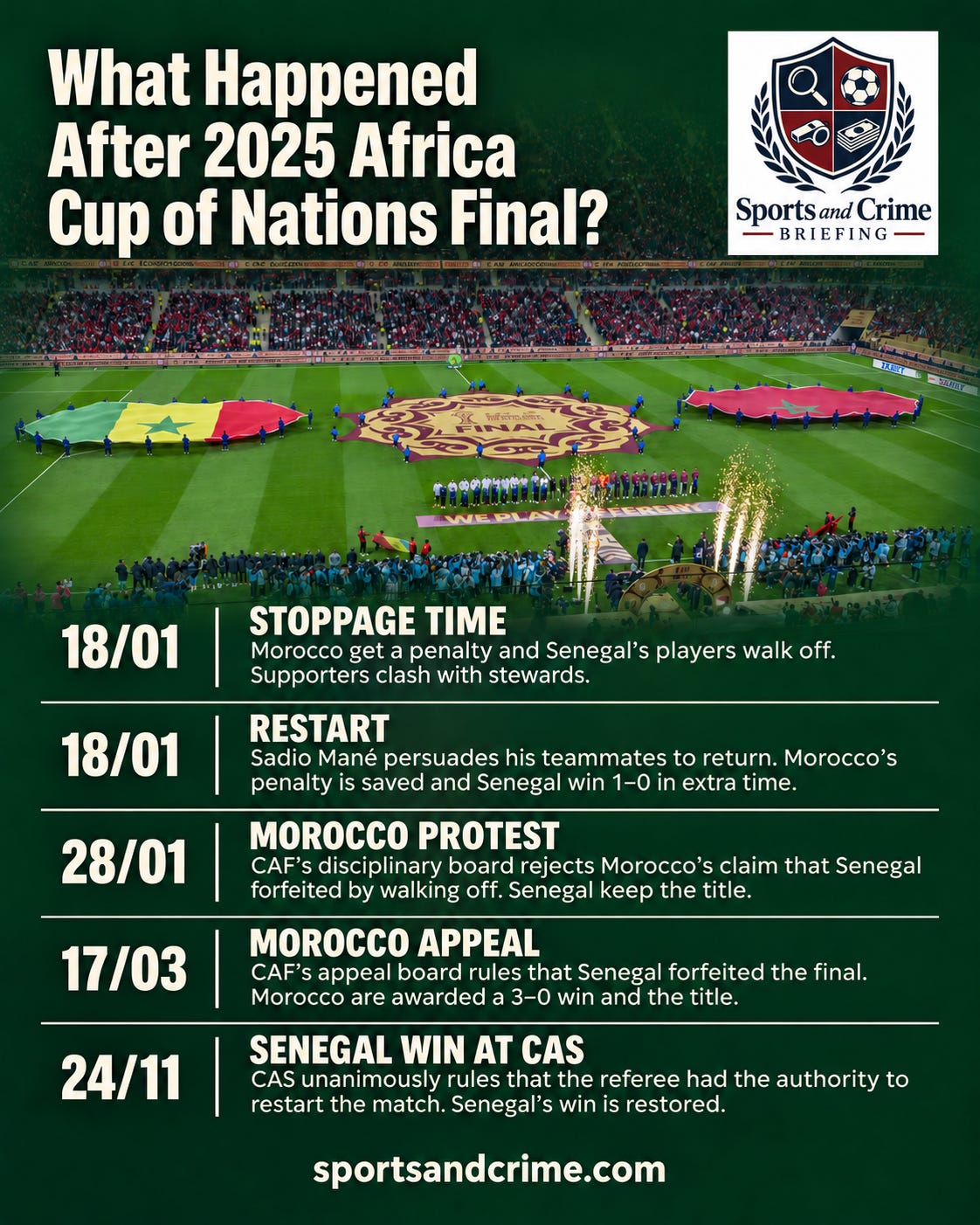
1. CAS reaffirmed the authority of the referee
When Senegal’s players walked off in Rabat, referee Ndala could have called off the Africa Cup of Nations final. When they returned, he observed that both teams were willing to play and blew his whistle for Morocco to take their penalty.
In restoring Senegal’s title, the Court of Arbitration for Sport reaffirmed that the decision belonged to Ndala alone. CAF’s Appeal Board had no grounds to substitute its own judgment for his two months after the match.
Morocco’s case depended on the argument that the walk-off itself had settled the final. But CAS ruled that Ndala could bring the players back, rejecting the interpretation used by CAF’s Appeal Board accepted in March when it awarded Morocco a 3–0 win.
The forfeiture provisions Morocco cited applied only if Senegal’s conduct had led the referee to abandon the match. The panel acknowledged the “atmosphere of extreme tension” in which he made his decision and found no evidence that he had acted arbitrarily or made an error of law.
CAF retained the power to punish the walk-off and its sanctions against Senegal’s federation, coach and players stand. But its disciplinary authority stopped short of allowing it to declare, after both sides had played to the final whistle, that the match had already been forfeited.
2. The French Word for “Forfeit” Caused Confusion
Article 82 of the Africa Cup of Nations regulations should be clear.
In English, Article 82 says that: “a team loses the match and is eliminated from the competition if, for any reason, it withdraws, fails to appear for a fixture, refuses to play or “leaves the ground before the regular end of the match without the authorisation of the referee”.
In French, it reads, “une équipe perd le match et est éliminée de la compétition si, pour quelque motif que ce soit, elle se retire, ne se présente pas, refuse de jouer ou « quitte le terrain avant la fin réglementaire du match sans l’autorisation de l’arbitre ».
For Morocco, the word quitte settled the final. Senegal’s players had left the pitch without the referee’s permission. Article 82 gave no grace period and said nothing about a forfeit being reversed if they came back.
Senegal argued that quitter, as CAF used it here, meant abandoning the match. Its players had returned to face the very penalty that prompted them to walk off.
The CAS arbitrators found that the verb alone could support either reading. What persuaded them was the rest of the article. The other three situations in Article 82 all leave the organisers with a fixture that cannot be played to a finish. Article 84 then explains how to score it. The opponents win 3–0 unless they already held a more favourable score when the referee stopped the match.
Senegal’s walk-off would have cost them the title if it had brought the final to an end. But the referee restarted play, both sides finished the match and the 1–0 result stood.
3. Players Who Walk Off Are Sent Off
Sadio Mané persuaded his Senegal teammates to come back out and finish the final. Under the rule now place, he wouldn’t have been able to.
On 28 April, the International Football Association Board approved a change to the Laws of the Game that competition organisers can choose to adopt. Where it applies, a player or coach leaving the pitch in protest at a referee’s decision is a red-card offence.
The number that matters is seven. A team that loses one player to a protest can still finish the match with ten. If five of its starting eleven are sent off, the referee cannot restart the game, however many of them have since changed their minds. A team responsible for an abandonment in those circumstances will, in principle, forfeit under the applicable competition rules. CAS acknowledged the change in its award. Senegal’s players could come back that night because the final took place in January, under the laws in force when they walked off.
4. CAF Left Morocco to Fend for Itself Aloneto let Morocco defend the decision that made it champion
On 13 April, less than a month after its own Appeal Board awarded Morocco the title, CAF told CAS that it would remain neutral and accept the outcome of Senegal’s appeal.
The Appeal Board had already explained its ruling in writing and its members had no separate case to argue in Lausanne. CAF itself, however, was a party to the appeal alongside Morocco. It could have asked the arbitrators to uphold the 3–0 forfeit but chose not to.
CAF has not always chosen such neutrality before. In the 2019 African Champions League final, Wydad Casablanca refused to resume play against Espérance de Tunis. CAF’s Disciplinary Board ruled that Wydad had forfeited, and its Appeal Board agreed. When Wydad took the case to CAS, CAF filed its own submission asking the arbitrators to reject Wydad’s appeal and confirm the Appeal Board’s decision “in its entirety”.
So why take a different position over Senegal?
CAF gave no reason in its letter, but there was one important difference. In the Wydad case, CAF could ask the arbitrators to uphold a conclusion both its boards had reached.
In Senegal’s case, its Disciplinary Board and Appeal Board were split. For CAF to defend Morocco’s title in Lausanne, it would have had to explain why its first board got the same final wrong.

5. CAS Recognized the Delay Probably Affected Player Performance
Sixteen minutes passed between Ndala awarding Morocco a penalty and Brahim Díaz taking it. In paragraph 179 of its ruling, CAS acknowledged that the tension surrounding Senegal’s walk-off and return had probably affected Díaz’s state of mind. The panel went as far as saying the episode had weighed on the player before he chipped his penalty into Mendy’s open hands.
The arbitrators made that observation while examining Morocco’s claim that the pressure in the stadium had compromised Ndala’s judgment. Having watched the footage, they thought the referee had kept his composure.
Díaz had spent much of the same period waiting to take a kick that could put the hosts ahead in stoppage time. CAS accepted that the interruption probably affected him, even while it concluded that Ndala’s decision to resume play was valid and overarching.