On 27 August, Red Star Belgrade supporters travelled to the Czech Republic to watch their club try to protect a 3-0 first-leg lead against Viktoria Plzeň in the Europa League playoffs. During the match, a banner appeared in the away end.
“Generale, večna slava i hvala.” “General, eternal glory and thanks.”
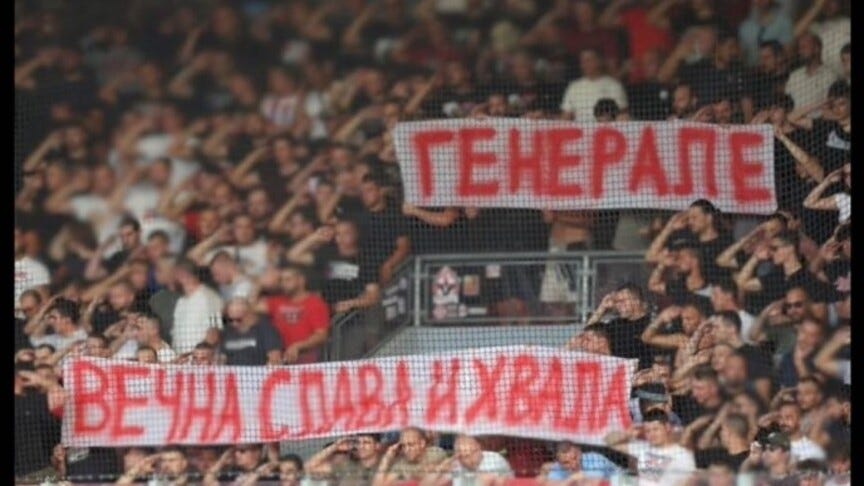
Supporters repeatedly chanted the name of Ratko Mladić.
Earlier that day, Mladić had died in UN custody in The Hague. The former commander of the Bosnian Serb army was serving a life sentence for genocide, crimes against humanity and war crimes committed during the 1992-95 Bosnian war.
His forces conducted the nearly four-year siege of Sarajevo, during which thousands of civilians were killed, and in July 1995 overran the UN-protected enclave of Srebrenica. More than 8,000 Bosniak men and boys were subsequently murdered. International courts ruled the massacre was genocide.
Mladić was also convicted over the persecution, murder and forcible removal of civilians across Bosnia, as well as the taking of UN peacekeepers hostage and using them as human shields. After spending 16 years avoiding arrest, he was captured in Serbia in 2011, sentenced to life imprisonment in 2017 and lost his final appeal in 2021.
The Red Star show of support was nothing unusual.
Its organised supporters, the Delije, have repeatedly celebrated Mladić, including during European matches. UEFA has already sanctioned the club for supporters chanting his name and singing that he was a “Serbian hero”.
This time, however, the support did not remain in the stands.
Red Star’s official X account posted a photograph of the banner with a single saluting-face emoji. There was no caption or attempt to distance the club from its message.
The Srebrenica Memorial Center filed an official complaint with UEFA on 28 August.“A club that knowingly uses its official communication channels to spread messages glorifying a man convicted by a final judgment of genocide cannot reduce such conduct to the behavior of fans,” the Center said.
It asked UEFA to permanently disqualify Red Star from European competitions, arguing that the club’s own involvement turned the case from supporter misconduct into a question of Red Star’s “institutional attitude” towards the principles governing European football.
UEFA rapidly opened disciplinary proceedings over alleged “racist and/or discriminatory behaviour” and “transmitting a message that is not fit for a sports event”.
Red Star Belgrade has not withdrawn from the furore. As of early on 29 August, the post was still up and the comments had been turned off.
What is the connection between Red Star Belgrade and Ratko Mladić?
Mladić retains support among some Serbian nationalist circles, despite his convictions for genocide, crimes against humanity and war crimes. To them, he was a military defender of the Serbian people and The Hague tribunal reduced a complicated war to Serbian guilt.
And there is broad tolerance for these displays of support. In 2023, the Youth Initiative for Human Rights documented 308 murals, graffiti and symbols celebrating Mladić across Serbia, more than 250 of them in Belgrade.
Serbian human-rights groups have spent years campaigning against his glorification, while journalists, activists and opposition figures have repeatedly challenged denial of the crimes established at The Hague.
But Red Star's Delije haven’t backed down.
Research into the group has found that Serbian national and Orthodox identity are central to the movement's self-image, with one study describing loyalty to the Serbian nation as an important part of how Delije members understand the group.
Who are the Delije?
The Delije were formally created in 1989, when several groups on Red Star’s North Stand came together under one name.
The group soon became led by Željko Ražnatović, better known as Arkan, who would become one of Serbia’s most brutal warlords and war criminals. already a career criminal with links to the Serbian security establishment.
Arkan was already a career criminal when he took over the Delije.
He was with Red Star supporters at the notorious May 1990 match against Dinamo Zagreb at Maksimir, when fighting between supporters and police engulfed the stadium as political tensions between Serbia and Croatia were already worsening.
Arkan established the Serbian Volunteer Guard in October 1990. Better known as Arkan’s Tigers, the unit was formed in part around men recruited from Red Star’s supporters.
At a derby against Partizan on 22 March 1992, uniformed members of the Tigers appeared in the North Stand. One after another, they raised road signs referring to Croatian towns captured during the fighting.
Arkan appeared before the stand and was applauded. Historian Richard Mills has documented the episode, as well as “Delije” graffiti appearing in Vukovar after the city’s destruction.
Mladić was not part of Delije directly, but he became a Serbian nationalist symbol that the club’s ultras have adopted.
The group has continued to use Red Star matches to express views on Kosovo, Republika Srpska and Serbian national identity.
Has Red Star been punished for supporting Mladić before?
Absolutely.
In 2018, thousands of Red Star supporters chanted Mladić’s name during a Champions League qualifier against Sūduva. This included the line: “My Mladić, your problem is that you are a Serbian hero.”
UEFA treated the incident as discriminatory behaviour and sanctioned the club. Red Star appealed, arguing that Mladić’s conviction was still under appeal, that the chants did not directly insult anyone and that praising him should not automatically be interpreted as attacking his victims.
UEFA rejected that argument. Its Appeals Body found that the chants could not be separated from what Mladić represented. Praising him also meant praising the values attached to a man convicted over ethnic cleansing and crimes against humanity. UEFA therefore considered the chants discriminatory.
The club also told UEFA during that 2018 appeal that it had already taken steps to prevent similar chanting in future and stressed that the incident involved only a small number of ultras.
Eight years later, Red Star supporters were again openly honouring Mladić, this time with official support.


