

On August 22, a robot beat Usain Bolt in Beijing.
Tiangong Ultra ran 100 metres in 9.39 seconds at Beijing’s World Humanoid Robot Games, beating Bolt’s 9.58-second human world record. Its closest rival, Lightning, developed by Honor, finished in 9.47 seconds.
Both were seemingly overwhelmed with their achievements. Tiangong failed to stop and slammed into the crash mats. Lightning collapsed beyond the line and was carried away on a stretcher.
Millions of people have watched the race and it has been covered by every major media outlet.
The records kept coming. The next day, Tiangong Ultra won the 400 metres in 38.15 seconds, comfortably inside Wayde van Niekerk’s human world record of 43.03. Another machine from the same Beijing research centre managed a 2.88-metre standing jump, compared with 0.95 metres at last year’s Games. The comparison with human high jump is imperfect, since the robot jumps from standing rather than using a run-up, but the improvement in a year is substantial.
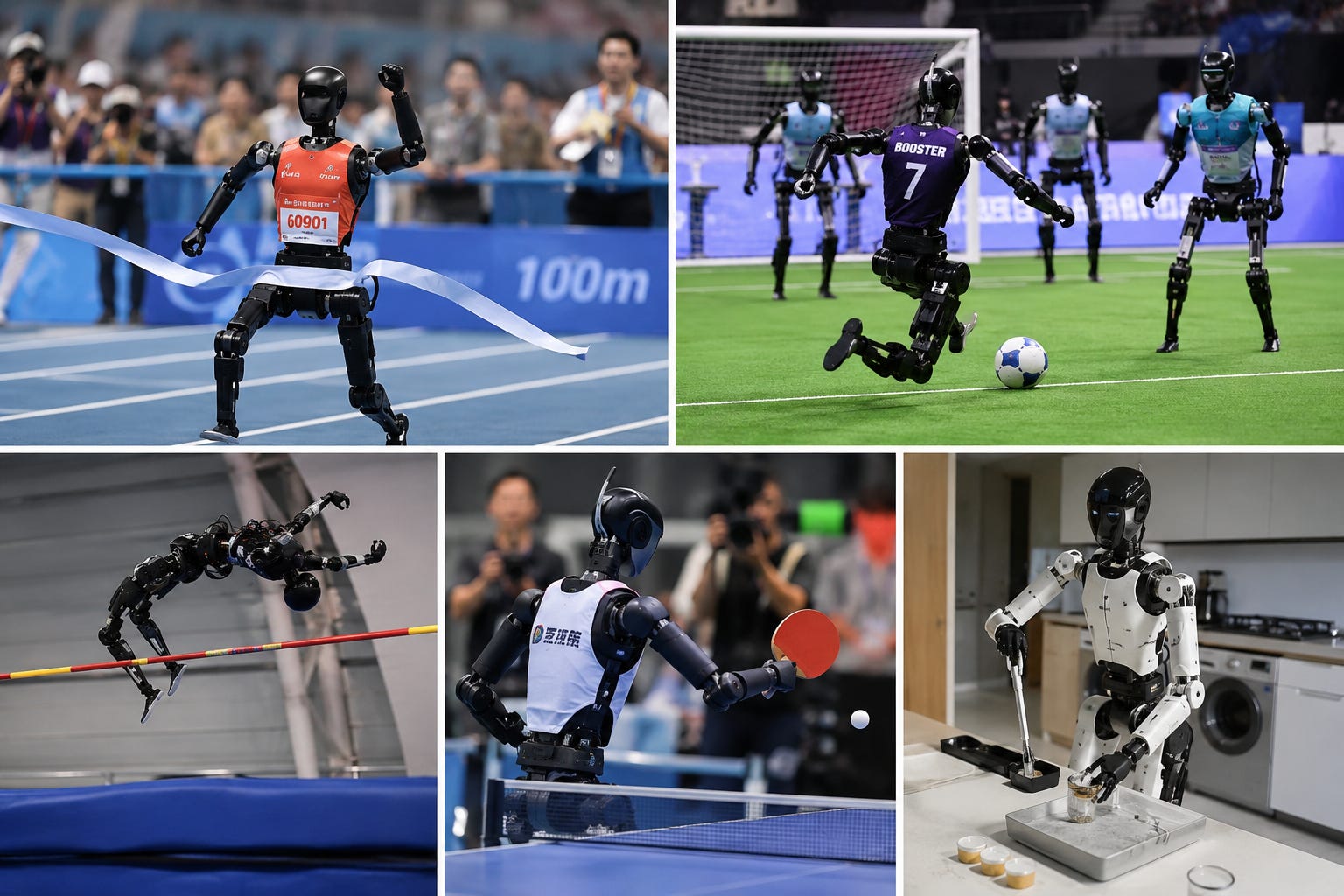
Speed was not the only attraction. An AgiBot Expedition A3 traded table-tennis rallies with Olympic champion Ding Ning without live remote control, tracking the ball through cameras, predicting its trajectory and selecting its own returns. Elsewhere, robots boxed, played autonomous football and attempted rather less glamorous challenges such as plugging in cables, weighing powder and moving individual beans with tweezers. Reuters neatly summarised the problem facing the industry: robots can now outrun humans, but useful work remains considerably harder.
Tiangong is not merely a robot athlete. It is a product of the Beijing Humanoid Robot Innovation Center, a Beijing-backed technology centre originally established with shareholders including Beijing Yizhuang Investment Holdings, UBTECH, Xiaomi and Beijing Jingcheng Machinery Electric. Company filings show the ownership structure, while subsequent financing has brought in further state and private investors including the Beijing AI Industry Investment Fund, Yizhuang Investment and Baidu.
Tiangong’s results are therefore a striking demonstration of the progress being made inside China’s heavily backed humanoid-robot industry. Last year, the winning robot needed 21.50 seconds to cover 100 metres. Twelve months later, Chinese machines are running the distance in less than ten.
The event is called the World Humanoid Robot Games.
Bu the “World” part is up for debate.
