Jose Mourinho's Long History of Denying his Players Could Ever Be Racist
From Fenerbahçe to Madrid to Chelsea, the Special One is consistent. Racism is minimised, claims are exaggerated, and his players are innocent.
Jose Mourinho is in hot water after dismissing allegations of racism by one of his players against Vinícius Júnior, but this is par for the course for the coach. The Sports and Crime Briefing revisits the Special One’s troubling habit of defending his players at any cost.
On February 17, in the 52nd minute of a Champions League clash between Real Madrid and Benfica, Vinícius Júnior pointed at Gianluca Prestianni and accused him of using a racial slur.
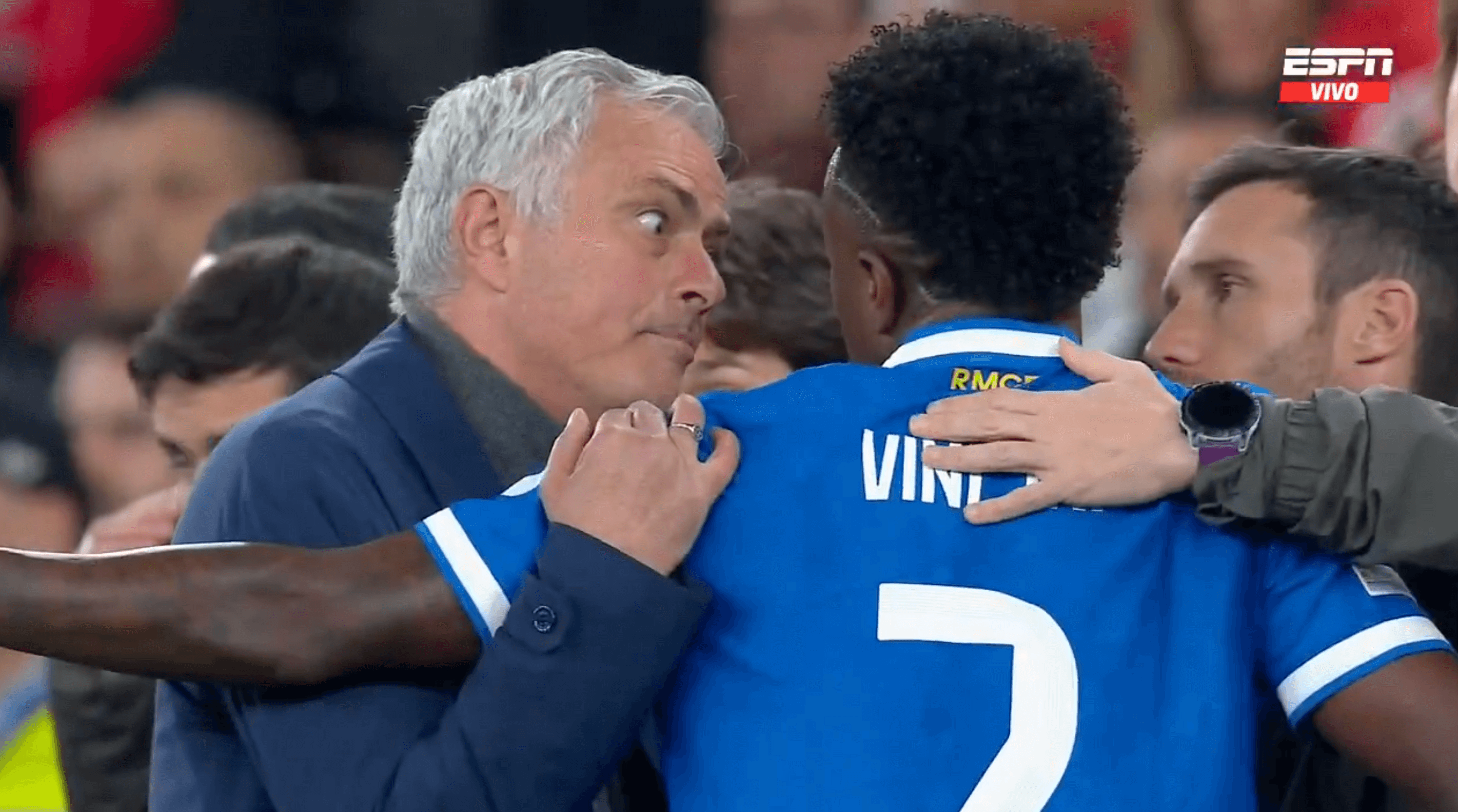
The referee stopped the match and activated UEFA’s anti-racism protocol. Real Madrid walked off the pitch although agreed to return and the match continued after ten minutes.
The fallout saw Benfica coach Jose Mourinho defend Prestianni in controversial fashion, suggesting Vinícius was making up the drama. “There is something wrong because it happens in every stadium,” Mourinho said after the match. “A stadium where Vinícius plays something happens, always.”
He also implied that Benfica was not a racist club as its greatest player, Eusebio, was himself Black. Images showing Benfica fans making racist gestures at Vinícius during the game contradict his statement. After the game, French star Kylian Mbappe said Prestianni used the term mono (monkey) five times.
Mourinho has rightly been lambasted for his comments, with Kick It Out accusing him of “gaslighting” Vinícius.
This was far from his first racial firestorm.
2025 – Fenerbahçe – “Jumping like monkeys”
On February 23, 2025, Fenerbahçe had just played out a bad‑tempered 0–0 draw away to Galatasaray in the Turkish Süper Lig. With tensions flaring before the match, both clubs pushed for a foreign official. UEFA’s Slavko Vinčić, a Slovenian who had handled Champions League knockouts, was brought in as a neutral firefighter.
Afterwards, Mourinho praised Vinčić for surviving “the jungle” of an Istanbul derby and said the game would have been a “disaster” with a Turkish referee. Then he turned his fire on Galatasaray’s bench, accusing them of trying to get his 18‑year‑old winger Yusuf Akçiçek booked with theatrical reactions to a challenge. Mourinho said a Turkish referee would have shown a yellow card “after the big dive and their bench jumping around like monkeys.”
Galatasaray reacted strongly. The club accused Mourinho of “racist statements” and “immoral comments,” as well as threatening criminal proceedings.
The next day, Fenerbahçe argued that Mourinho’s words had been “deliberately taken entirely out of context and distorted in a misleading manner.”
“As any reasonable person can clearly recognize,” the club said, “the expression used by José Mourinho was solely intended to describe the excessive reaction of the opposing team’s technical staff to the referee’s decisions during the match. These remarks cannot, under any circumstances, be associated with racism.”
The TFF did not accept this defence, banned Mourinho for four matches and fined him more than €40,000 for Mourinho. However, its decision did not use the word racism, instead couching his behaviour as incitement and disorder.
Mourinho countered that racism was “not one of my bad qualities, exactly the opposite” and countersued Galatasary for defamation.
Former Chelsea players under Mourinho, Didier Drogba and Michael Essien, rallied to his defence, denying that he had ever been a racist.
2011-2012 – Real Madrid – “Terry not racist”
On October 23. 2011, Chelsea travelled to Loftus Road to face Queens Park Rangers in the Premier League. The two captains, John Terry and Anton Ferdinand, collided with each other and had a brief argument.
TV cameras caught Terry mouthing words at Ferdinand, which lip-readers and witnesses said was “fucking black cunt.”"
The referee didn’t see it, but the fallout was seismic. Terry was charged by the police with a racially aggravated public order offence. He was stripped of the England captaincy.
During his 2012 trial, Terry accepted that he had used the words, but only repeating them “sarcastically” because he thought Ferdinand had used them first. He was acquitted by Westminster Magistrates’ Court, but the FA fined Terry £220,000 for “abusive and/or insulting words and/or behaviour.”
Jose Mourinho was not Chelsea manager at the time. But Terry was his former captain at Chelsea and Mourinho spoke to CNN two days after the FA verdict.
“He is not a racist, that’s 100 percent” Mourinho said. “Probably he had a racist comment or a ‘racist’ attitude against an opponent,” but this was “in the heat of the moment.”
“We had a squad where we had 12 African players in the squad,” Mourinho said of his Chelsea teams. “It was a fantastic squad and he had always a great relation with every one of them. Please don’t say that he is a racist.”
He claimed he had never witnessed or felt racism in any of his dressing rooms, and that he had always had African players in every team he managed.
2009 – Inter – “Not racism, ignorance”
On April 18, 2009, Inter travelled to Turin to face Juventus in the Derby d’Italia. Mario Balotelli, then 18 years old, started up front. Born in Palermo to Ghanaian parents and raised in Brescia, he was already a lightning rod in Italian football.
From the Curva Sud at Juventus’s temporary Stadio Olimpico ground came a now-infamous chant: “Non esistono neri italiani” - “there are no Black Italians.” Balotelli was repeatedly targeted with monkey noises and racist songs throughout the 1–1 draw. The incidents were serious enough that police opened an investigation, and the Italian federation later ordered Juventus to play a home match behind closed doors as punishment.
Some at Inter defended their player immediately, with captain Javier Zanetti vowing to halt future matches if this continued.
Mourinho, then the coach of Inter, took a different line.
“I don’t think it’s racism,” he told reporters two days after the game. “It’s an ignorant, stupid, infantile way to show that I don’t like this player.”
He insisted the abuse was about football, not race: “They don’t like that he is a great player, that he scores against their team, that he is difficult to mark.”
To support that argument, he pointed out that Juventus had Black players of their own, such as Malian midfielder Mohamed Sissoko. “If it’s racism, it’s racism for all,” Mourinho said, “not just for opposition players.”
Later that year, Sissoko was himself subjected to racial abuse during a Juventus match against Cagliari.


Thanks for this interesting piece.
Mourinho coached Inter.
The heat of the moment argument is used for all kinds of problematic behaviors.
What is said is really hard to regulate. This is not an attempt to excuse behavior, but the current protocol seems to draw more attention to some issues (does this Ameliorate or exacerbate the problem? Lots of focus on racism (which is an issue), but should also focus on homophobia, and other problems,
We should also properly investigate players that go to changing rooms to attack others. Or players who are accused of different crimes.
Sport affects these issues in all kinds of weird ways.