

Konstantinos Firinidis, founder of a Greek charity for sick children, allegedly offered to pay a referee €300 for acting biased in a match. But that wasn’t enough to every decision.
Finnidis was willing to pay more, another €300, to have an opposing player sent off.
And how was he paying for this? Using money that he had helped raise from the public to help children with school illnesses.
Who is Konstantinos Firinidis?
Firinidis, 37, has spent years asking the public to help children with serious illnesses. In 2013, he founded Paidiki Chara, meaning Child’s Playground, a charity in the Greek city of Thessaloniki, was a major part of its public appeals, and appeared on television seeking donations.

Paidiki Chara’s website promises that donations collected for children reach them in full. Police believe differently.
Investigators say donations collected in children’s names moved into personal accounts or were spent elsewhere, and only a small part reached the families.
More than €250,000 was allegedly used to finance Aiginiakos and Vataniakos, two lower-league clubs in Pieria, northern Greece. Firinidis had previously been president of Aiginiakos and remained one of its principal financiers after leaving office. By the 2026–27 season he was backing Vataniakos, seeking promotion from Pieria’s top amateur division to the national third tier. The money paid players, coaches and suppliers in cash.
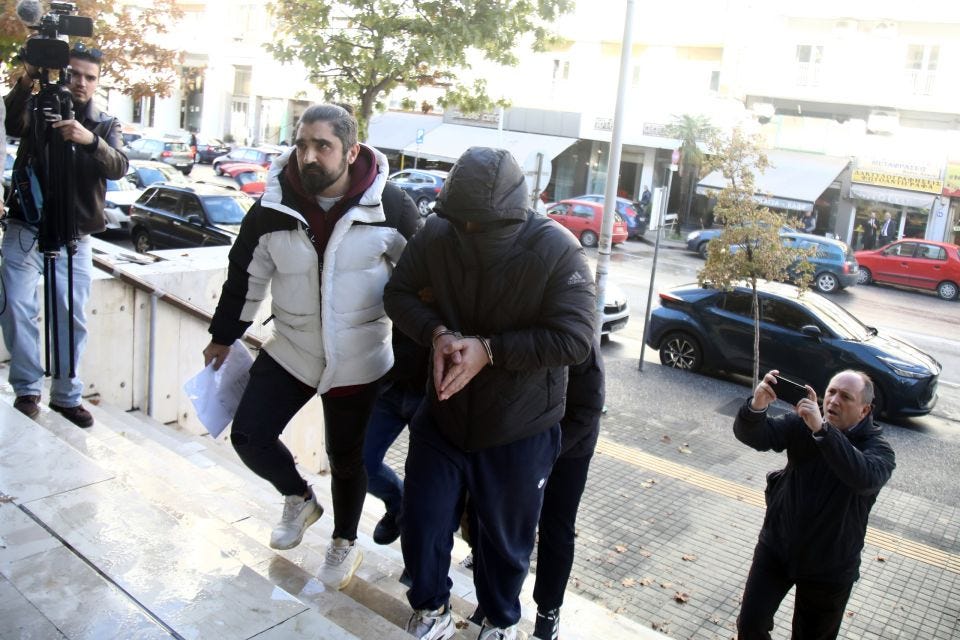
Firinidis was arrested, alongside five others on 30 October and denies the allegations.
How did the scam work?
Paidiki Chara posted photographs of seriously ill children and asked the public to help their families pay for treatment, hospital stays, travel and temporary accommodation. The campaigns weren’t anonymous. Donors were shown a particular child and the expenses their contribution was meant to cover.
Some of Greece’s best-known athletes took part in good faith. In August, tennis star Maria Sakkari gave €8,000 for a boy awaiting a transplant. Panathinaikos midfielder Tasos Chatzigiovanis gave €12,500 towards another boy’s operation. Paidiki Chara advertised these famous donors to appeal to an even larger audience.
But shady actions appear to have been part of the plan since the beginning. Police state, that across 92 appeals, the charity reused children they had already completed campaigns for, changing photographs, names and details to avoid being spotted.
Media outlet To Vima revealed that Firinidis told a father to use a fake name, change his phone number and deny any claims that he might have worked with the charity before. When the father worried that people would recognise his child from a previous fundraiser, Firinidis said they would use other photographs.
The mother of a child with cancer tried to raise money alone. According to police, charity staff deposited money into her bank account, then reported the account to the bank for fraud. The account was disabled. Only then did Paidiki Chara step in and offer to help her collect donations.
Police zeroed in on appeals for 34 children which collectively raised €3.94 million. Their families received €1.11 million, or about 28 per cent.
Some of the allegedly embezzled cash went straight into Firinidis’ football activities. Police also two allegedly fictitious companies and a sole-trader business used to hide the transfer and generate false invoices.
How did Firinidis influence matches?
Firinidis’s role in Pieria football was hardly a secret. When Aiginiakos announced its new board in June 2024, it named Firinidis as one of its principal financiers, although he could not join the board because he had played for the club too recently.
By September 2026, Firinidis was backing Vataniakos instead. Its second league match of the season, on 19 September, was against Aiginiakos. In a recorded conversation four days earlier, an unidentified Vataniakos figure told him a particular referee would be appointed and would make sure their team won.
The chair of the Pieria football association’s refereeing committee, identified as Nikolaos Karaisaridis, helped decide who would take charge of its local matches. He arranged for a referee, named Giorgos Aslanidis, to run the Vataniakos against Aiginiakos game. Aslanidis has denied any wrongdoing and his lawyer said the referee’s name was used without his knowledge.
In the conversation published on November 1, Firinidis boasted he had bribed a chief refereeing official to appoint the officials he wanted and discussed €300 for a favourable referee, with another €300 if a named opponent was sent off.
Aslanidis and Karaisaridis were arrested on 30 October and released under conditions after questioning on 3 November. Greece’s central refereeing committee has removed both men.
Vataniakos won 2–1. It received two penalties and Aiginiakos player received a red card. According to Voria’s account of the recorded conversations, Firinidis had objected before kick-off to a camera being visible to the referee. During the match, he described the first penalty and red card to a caller as unjustified. Afterward, he complained to a relative that winning had cost €1,000. Police allege that sum was paid to influence the refereeing of this match; it is a separate allegation from the €300 conversation.
Backing a club, betting on its defeat
But Firinidis’ machinations didn’t stop there. He also allegedly bet on Aiginiakos. During the 2024–25 season, while he was financing the club, police say he placed 62 bets on its matches, both betting for the club to both win or lose.
The investigation is also reaching beyond these two clubs.
On 27 September 2026, Asteras Tripolis faced Iraklis in Greece’s under-19 league, with Aslanidis refereeing. According to Voria’s account of the po and encouraged friends to do the same. In a published conversation, he urged a contact to back both teams to score and more than 2.5 goals. He later claimed to have staked about €1,400 and collected €7,000.
Firinidis was a huge gambler. Police traced more than €2.6 million paid into betting accounts and more than €2 million withdrawn.
The promotion race continues
Police say the alleged arrangement was meant to favour Vataniakos throughout its promotion campaign in the current season, with particular attention to matches against its closest rivals.
Those matches are next: GAS Svoronou on 7 November and AO Paralias on 14 November. After eight games, Vataniakos leads each by two points. A result against either could change who leads the division.
The officials named in the investigation have been removed from their positions but the matches will still attract great scrutiny. And the investigation may affect Vataniakos’ season to come, if games are proven to be fixed.