FIFA Has Protected its Stars Long Before Balogun
From Garrincha to Ronaldo, FIFA has often stepped in to ensure its most valuable players would not be penalized for their actions. But it's happening more often than ever in 2026.
UEFA and FIFA have clashed repeatedly in recent years, but UEFA’s response to FIFA’s decision to lift the red-card sanction against US striker Folarin Balogun was unusually blunt.
FIFA ruled that Balogun’s automatic one-match suspension would be suspended for a one-year probationary period, clearing him to play in the United States’ World Cup Round of 16 match against Belgium. UEFA responded by accusing FIFA of going beyond a routine disciplinary judgment and undermining the authority of referees.
“Yesterday’s decision to suspend for a probationary period of a year the implementation of the one-match automatic suspension following the red card issued to the player Folarin Balogun crossed a red line,” UEFA said in a statement.
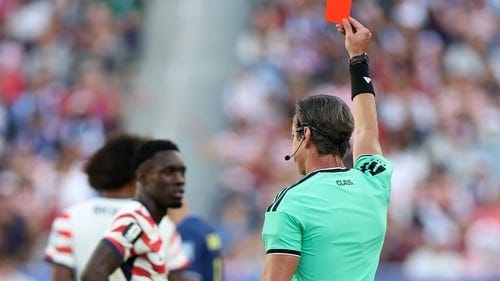
Belgium called the decision similar to April Fool’s. It then lodged a formal appeal within hours, claiming that FIFA had interfered in the integrity of the competition, perhaps at the behest of US President Donald Trump.
That this happened at the World Cup made the Balogun decision immediately controversial, but this is not the first time FIFA has intervened after a red card at a major tournament.
How FIFA intervenes
The Balogun case is the most politically charged example, but it is not the only way FIFA has intervened in red-card sanctions.
In Balogun’s case, FIFA did not erase the red card itself. It suspended the implementation of the automatic one-match ban for one year under Article 27 of its Disciplinary Code, allowing him to play against Belgium while leaving the sanction hanging over him during a probationary period.
The direct modern precedent was Cristiano Ronaldo. In November 2025, Ronaldo was sent off during Portugal’s World Cup qualifier against the Republic of Ireland after he was judged to have elbowed Dara O’Shea. The red card, upgraded after a VAR review, was the first of Ronaldo’s senior international career.
FIFA imposed a three-match ban, the standard punishment for violent conduct, but Ronaldo served only one match, Portugal’s final qualifier against Armenia. The remaining two games were suspended for a one-year probationary period under Article 27, clearing him to play at the start of the 2026 World Cup.
FIFA used a different mechanism for Nicolás Otamendi and Moisés Caicedo. Both were sent off in Ecuador’s 1-0 win over Argentina in the final round of South American World Cup qualifying in September 2025.
Under the normal logic of tournament discipline, both players were expected to miss the opening match of the 2026 World Cup. But in May 2026, FIFA amended Article 10.2 of the World Cup regulations so that certain one- or two-match suspensions from qualifying would no longer carry over into the final tournament. Unlike Ronaldo and Balogun, this was not a ruling on an individual punishment, but a broader rule change affecting a category of offences.
The change cleared Otamendi and Caicedo to play at the start of the World Cup. FIFA said the amendment was intended to allow countries to field their strongest teams while preserving disciplinary fairness and the integrity of the competition. The controversy lay in how the change came about.
The Argentine Football Association (AFA) said it had negotiated with the FIFA Bureau to allow Otamendi to play, while CONMEBOL president Alejandro Domínguez was involved in discussions covering both Otamendi and Caicedo.
In other words, FIFA changed the competition rules shortly before the tournament, after lobbying from powerful football bodies.
So this only began happening at the 2026 World Cup?
Far from it. World Cups have long produced moments in which discipline, refereeing, and political pressure have collided.
One famous case matches Balogun closely.
Brazil’s winger was the tournament’s decisive player after Pelé suffered a groin injury in the second match. In the semi-final against hosts Chile in Santiago, Garrincha scored twice in a 4-2 win before being sent off for retaliating against a Chilean opponent.
At the time, red cards were not used yet and a sending-off carried no automatic next-match ban. FIFA’s disciplinary committee decided each punishment after the fact, which left room for discretion that a fixed suspension would not have. Brazilian officials lobbied the committee directly.
The referee reported that he had not seen the incident clearly and had acted on the advice of a linesman who had since left Chile, weakening the evidentiary basis for any ban. Garrincha was cleared. He played in the final, and Brazil beat Czechoslovakia 3-1.


