

Kylian Mbappé was having his make-up done when he was asked which internet meme of himself made him laugh the most.
In backstage footage recorded earlier this year for a French talk show, he recalled a video that had put his face on “a guy — I think he’s a Chinese dictator”. He added that he used it with friends while playing games online. The clip was posted on 26 October.

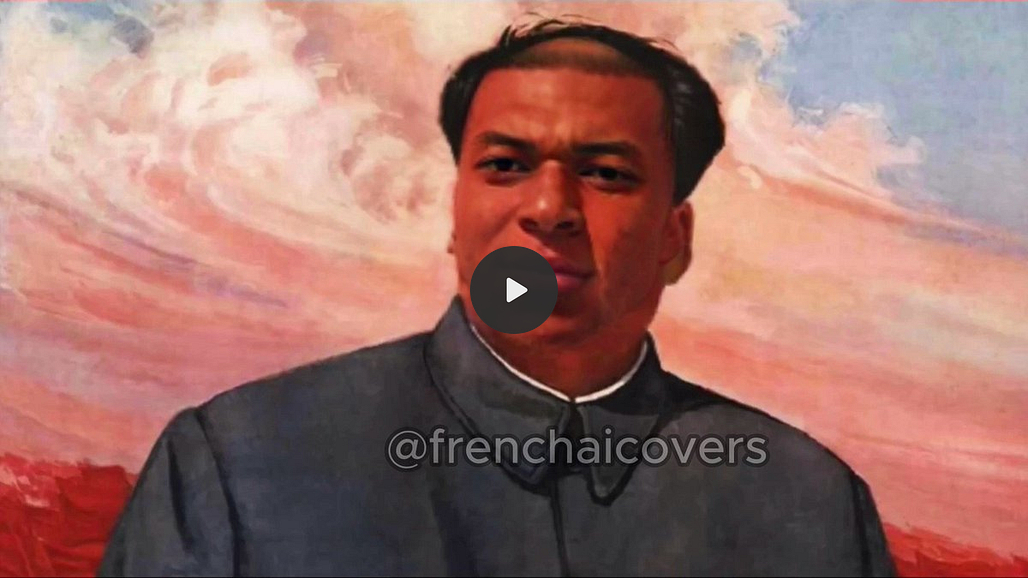
He was referring to a video depicting him as Mao Zedong, the founder of the People’s Republic of China. Mbappé did not name Mao directly. The edited interview then cuts to the meme, showing the footballer’s face on Mao’s body.
The joke of Mbappé as a dictator, for his perceived power over his clubs and teammates, has never sat particularly well with him. But the controversy has now grown beyond belief.

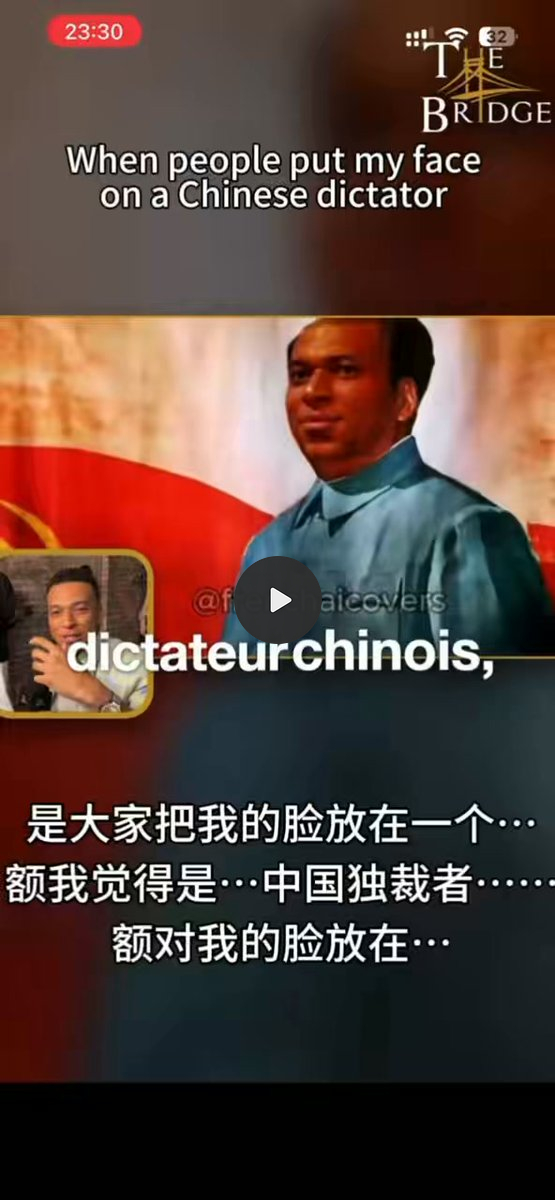
China is now taking steps to eliminate one of the world’s most recognizable faces from advertising, the media, and indeed the entire Chinese Internet.
China’s leaders do not like mockery. Comparisons between Xi and Winnie the Pooh prompted the cartoon bear to be banned. Mao, whose portrait still overlooks Tiananmen Square, is similarly protected from ridicule.
But, even by Chinese standards, what has followed Mbappé’s remark is one of the most comprehensive attempts to erase a foreign athlete from Chinese public life.
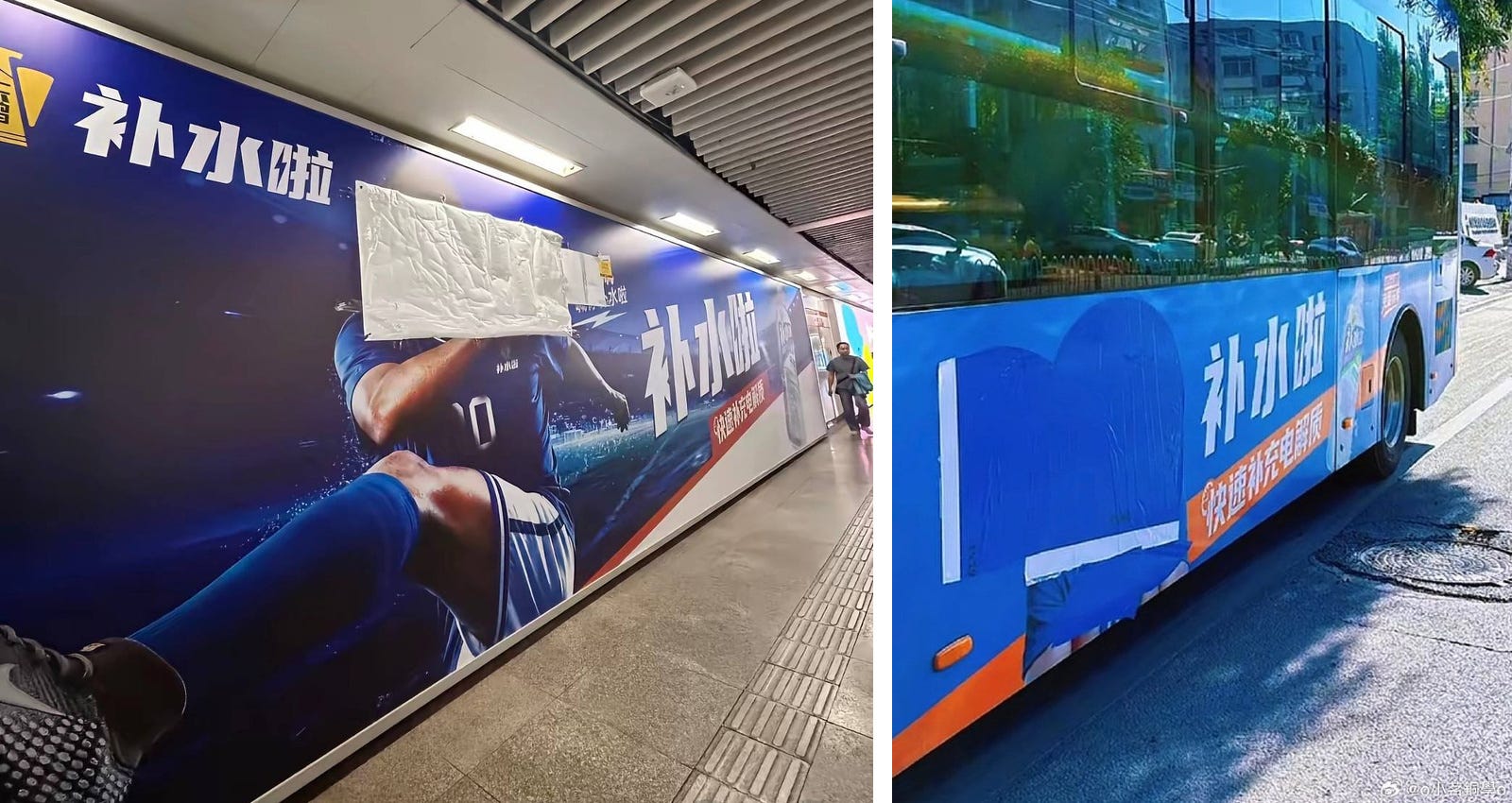
State television suspended La Liga broadcasts. Social platforms restricted his accounts. Brands removed material featuring him, stores put tape over his face on products sponsoring him, billboards were covered up, he was even cut out of drinks packaging.
On 27 October, drinks company Dongpeng, dairy giant Mengniu and cheese brand Milkground ended their partnerships with him. Dongpeng makes the blue-labelled Bushuila drinks featured below. Companies that had paid to put Mbappé in front of Chinese consumers were now distancing themselves from him, invoking the protection of national sentiment.
The photographs show how literal that separation can become. Their original capture details remain unverified, but alongside the documented restrictions, they reveal a backlash reaching from television schedules to the label on a single bottle.
First, the sponsors pull out
On 27 October, drinks manufacturer Dongpeng and dairy giant Mengniu announced that they were ending their partnerships with Mbappé. Their statements used strikingly similar language about opposing behaviour that hurts national sentiment.
Dongpeng has Mbappe all over adverts for Bushuila, their electrolyte drink, on public transport, subways and bottles.
It had signed Mbappé in April, ahead of the World Cup. Six months later, his face was being covered up.
The financial consequences could run into the millions. Le Monde, citing specialist media, put the combined value of his Dongpeng and Mengniu contracts at approximately 50 million yuan (€6.7 million).
Dongpeng told the National Business Daily that management discussed the controversy immediately after learning about it before midnight, then issued its cancellation statement the following morning.
There was almost certainly pressure from Beijing for them to act swiftly.
Beijing’s response: apologise, then prove it
On 27 October, the controversy reached China’s Foreign Ministry. Asked about the cancelled sponsorships, spokesman Guo Jiakun gave this response:
“Words and actions that hurt the feelings of the Chinese people will naturally meet joint resistance from all sectors of Chinese society.”
An offhand remark about Mao had become an injury to an entire population. This is hardly a new stance. “Hurting the feelings of the Chinese people” is short hand for “Apologise now and butt out.”
The state broadcaster took rapid action. China Media Group (CMG) suspended broadcasts of La Liga matches, all matches involving Mbappé, and his endorsement adverts on 26 October.
One player’s offhand remark got an entire league booted off TV.
CMG demanded immediate public apologies from Mbappé and Real Madrid, plus a written apology to the broadcaster itself. When La Liga president Javier Tebas wrote to condemn the remarks and apologise, CMG insisted that the league, the club and especially the player must all apologise publicly.
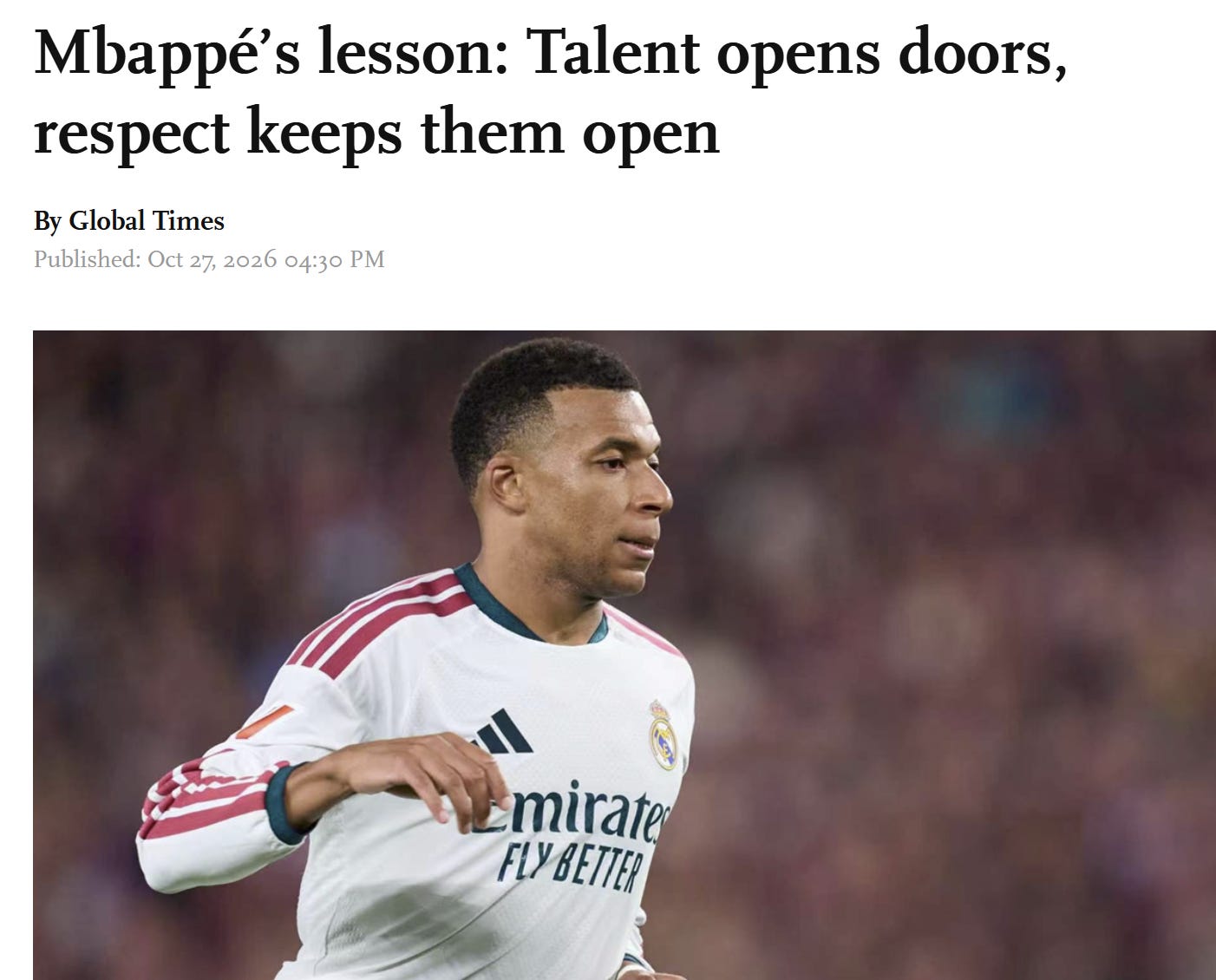
But even an apology did not settle it. After Mbappé apologised on 27 October, CMG said it would judge his actions as well as his words. It expected him, Real Madrid and La Liga to “learn a lesson” and “mend their ways”.
On 28 October, the broadcaster lambasted Mbappe further, declaring that his remarks had gone “beyond the scope of freedom of expression”. It also held Real Madrid responsible for its player.
But his ability to even speak to Chinese fans has been restricted.
One of China’s largest sports websites, Dongqiudi, explained in its statement condemning Mbappé, that his remarks had harmed China and the Chinese people, so “we cannot translate” them. It nevertheless assured readers that his words were unacceptable.
Readers were given the verdict without being allowed to read the guit
Mbappé erased from the Chinese internet
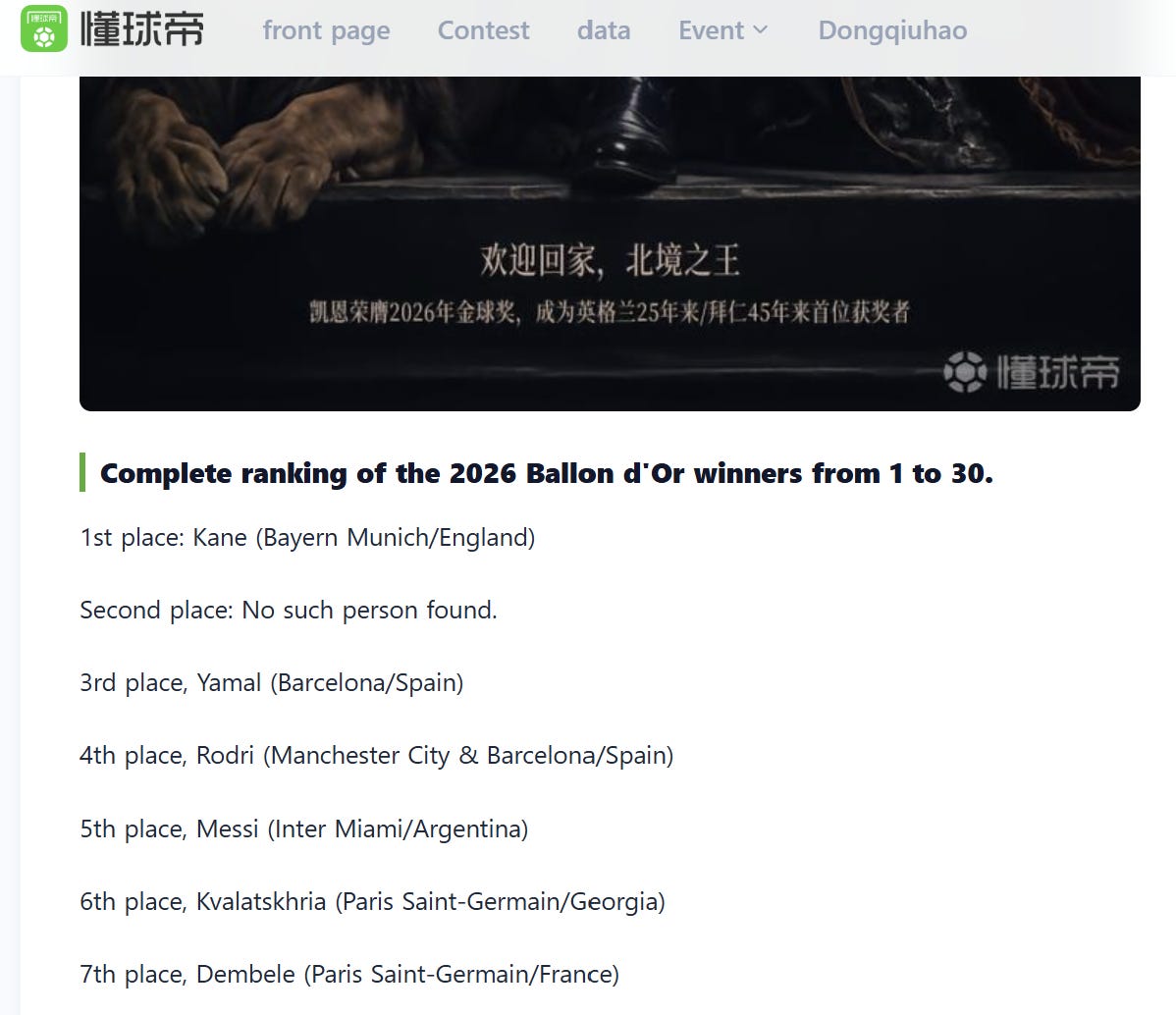
Look up the 2026 Ballon d’Or results on Chinese football platform Dongqiudi. Harry Kane is first. Lamine Yamal is third.
In second place: 查无此人 — “No such person found.”
Mbappé finished runner-up. Dongqiudi kept his position in the ranking but replaced his name with the language of a failed records search. An impressive finish for someone who apparently does not exist.
His own accounts were silenced, too. By 27 October, Weibo and Xiaohongshu had barred Mbappé from posting. Xiaohongshu also blocked new users from following him. Weibo invoked violations of “relevant laws and regulations”; Xiaohongshu cited community rules. Both accounts remained visible, carrying notices explaining why their owner could no longer speak.
When AFP searched Dior’s and Hublot’s Weibo pages using Mbappé’s Chinese name, it found no results. This was erasure within those brands’ accounts, rather than evidence that every Chinese search engine had stopped recognising him.
Even the versions of Mbappé in video games have been censored. At least eight football games have stopped promoting him, removed his character, or made other changes.
Dedicated software updates were rolled out to remove him.
Is there a way back for Mbappé in China?
There can be. But previous cases suggest that a club or league can regain access long before the person who caused the controversy returns to favour.
Take Mesut Özil. After he condemned China’s treatment of Uyghur Muslims in December 2019, broadcasters dropped Arsenal matches and his character disappeared from Chinese versions of football games. Arsenal’s exclusion was brief: within a fortnight, streaming service PPTV was showing its matches again. But during the Boxing Day game against Bournemouth, commentators avoided saying Özil’s name, even when announcing the other ten players in the starting line-up.
Arsenal was allowed back. Its midfielder remained unmentionable.
Enes Kanter’s Boston Celtics returned after roughly six months. Tencent stopped showing their games in October 2021 after he criticised Beijing’s treatment of Tibetans and called Xi Jinping a dictator.
By April 2022, Chinese streaming platforms were carrying Celtics games again. Kanter had already left: Boston traded him to Houston that February, and the Rockets waived him. Boston’s restoration came with the outspoken player off its roster.
The Houston Rockets had to wait 15 months, despite once being the home of China’s basketball superstar, Yao Ming.
Their games disappeared after general manager Daryl Morey supported Hong Kong’s protesters in October 2019. Tencent finally showed them again in January 2021, after Morey had moved to the Philadelphia 76ers. Philadelphia’s games were still excluded at that point. The 76ers did nothing wrong, but the punishment effectively followed him to his new employer.
But returning to screens did not immediately restore the Rockets’ commercial relationships. In May 2022, the Houston Chronicle reported that they still had no sponsorship agreements with China-based companies.
Pro wrestler John Cena demonstrated the other available response: apologise, emphatically and publicly.
In May 2021, while promoting Fast & Furious 9, Cena referred to Taiwan as a country. He subsequently recorded an apology in Mandarin, telling Chinese viewers: “I love and respect China and Chinese people.” Some commenters demanded that he go further and explicitly declare Taiwan part of China.
His film remained in Chinese cinemas.
That is where these campaigns acquire their preventive power. Punishing a player’s club and league gives everyone around him a financial incentive to supervise what he says. Agents, sponsors and communications departments can anticipate the next controversy without waiting for Beijing to issue instructions.
In Mbappé’s case, that institutional response is already visible. La Liga’s apology included a commitment to develop an “awareness and communication protocol” with clubs and players. One player’s backstage remark has prompted an entire league to promise measures intended to prevent a repeat.
The coverings may eventually come off. But the warning will remain.
The Dictator has been cowed.