Teenage Sudanese arriving in Australia to play football are being targeted by match fixers, according to the Federal Sports Minister, Anika Wells.
However, evidence to support such a claim is hard to find.
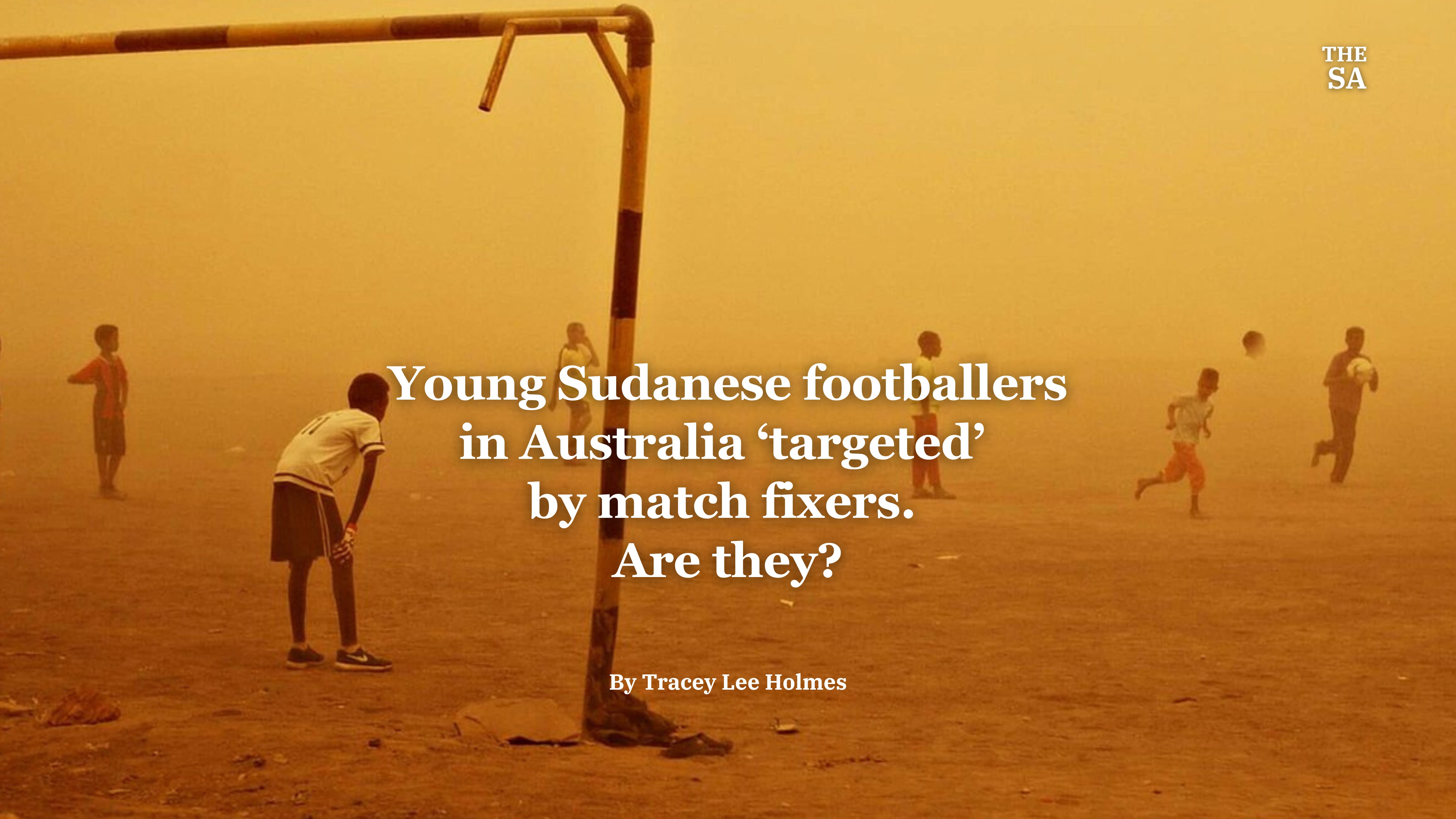
“At the moment we have situations where vulnerable nineteen-year-olds come from Sudan to play in domestic soccer leagues, or in the under nineteens, and they are targeted for match fixing by overseas operators,” Minister Wells told a room full of journalists in late August.
This article was written by Tracey Holmes and originally published in The Sports Ambassador. Across Substack and her podcast, Tracey does an outstanding job at holding sports authorities to account. It is republished here with her kind permission and I encourage you to subscribe and support her work.
When asked by The Sports Ambassador podcast, none of the major football organisations working in governance, delivery of competition, integrity, and player representation were aware of such specific ethnic targeting in their sport.
British is the nationality that has appeared most in Australian match fixing cases, dating back to the well-documented Southern Stars case in Melbourne 2014.
Australia has no shortage of talented footballers. It is the number one ranked organised team sport in terms of total registered players across age and gender categories.
Suggesting teenagers are coming to Australia from Sudan to play football seems unlikely given the difficulty Sudanese people face in obtaining visas.
This Substack is reader-supported. To receive new posts and support my work, consider becoming a free or paid subscriber.
Sudan has been described as ‘the abandoned crisis’ by the Refugee Council of Australia (RCA).
The despair engulfing the country is multi-dimensional and catastrophic: a declared famine since 2024 and a brutal civil war between the Sudanese Armed Forces and an armed paramilitary group known as the Rapid Support Forces.
More than 11 million nationals have been declared stateless and another six million are displaced internally, according to UNHCR.
“The Sudanese community in Australia is deeply affected by the crisis,” the RCA announced in April in calling for broader and more accessible visa pathways.
“Current options are limited, and the cost and eligibility requirements for family visas place them out of reach for many.”
When asked for clarification to support Minister Wells’ comments, a spokesperson said:
“The Australian Government is concerned that match-fixers target young and financially vulnerable athletes as well as those from developing nations.
“All athletes deserve protection from being targeted by match-fixing. The laws introduced to Parliament will ensure greater protections from match fixing for everyone involved in sport.
“Sports Integrity Australia continues to work with all stakeholders to provide education on the dangers of sports manipulation.”
But the Federal Sports Minister did not say that; she singled out Sudanese athletes as she answered a question about new legislation seeking to criminalise certain behaviours associated with match fixing.
Minister Wells presented no evidence to support her claim; her office says her comments were ‘illustrative’.
Sentiments about the need for athlete protection is not lost on the player association, Professional Footballers Australia (PFA).
When asked whether the PFA had any knowledge of Sudanese players being targeted by match fixers, Chief Executive Beau Busch said:
“We are not aware of the specific case of players being targeted by match fixers as referenced by the Federal Sports Minister.
“However, it is clear that match fixing continues to pose a significant challenge for the industry and protecting our people.
“The research is clear that a variety of factors contribute to its prevalence, including addiction, financial distress and a lack of education and support services.
“As such we need to move from an approach that is solely focused on sanctioning to one that proactively tackles the biggest known contributing factors such as addition, non-payment and financial vulnerability.”
Back in 2019 Australia was the first non-European country to become a signatory to the EU’s treaty to combat the global scourge of match manipulation, known as the Macolin Convention.
Seven years later, as part of national gambling reforms, which don’t go far enough according to critics, new legislation has been introduced to criminalise a suite of offences associated with match fixing.
Minister Wells explained last week it was part of the government’s ‘holistic approach’ aimed at cracking down on some of the sources of illegal gambling as well as ‘those who profit from it’, including up to ten years in jail for those found guilty.
Twenty-four hours before writing this, Football Australia was asked for a comment. A spokesperson said they required more time.


